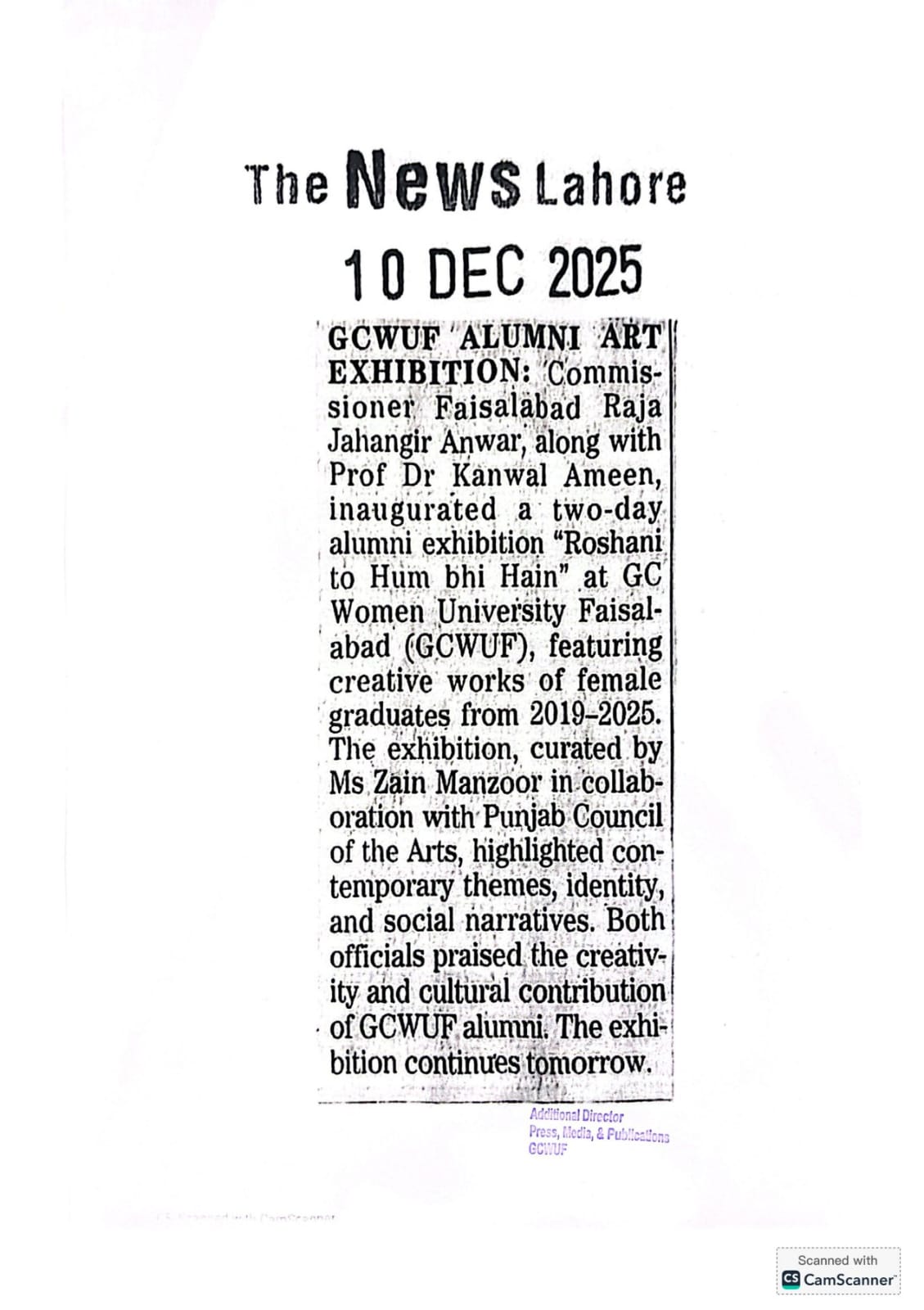

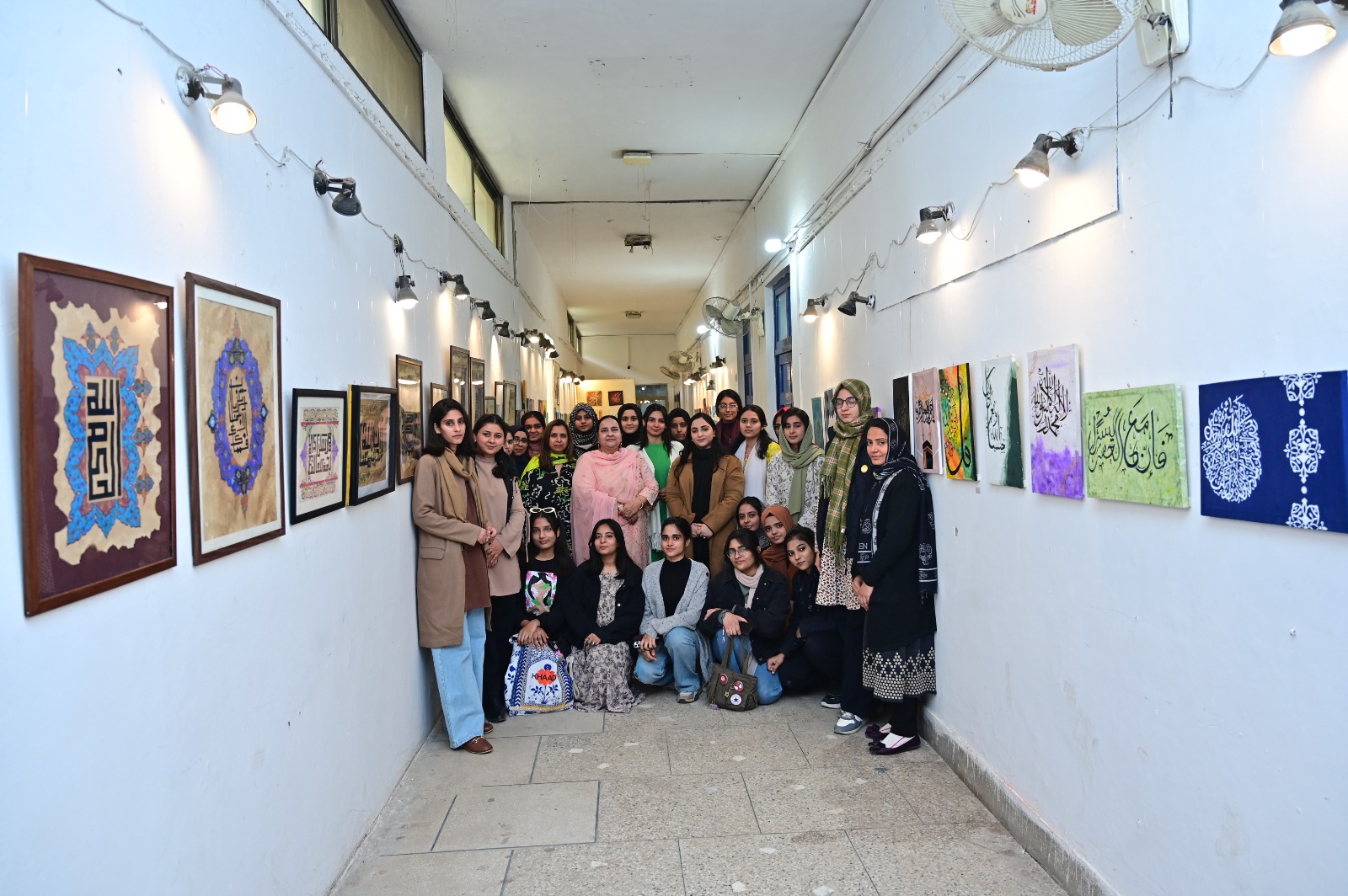
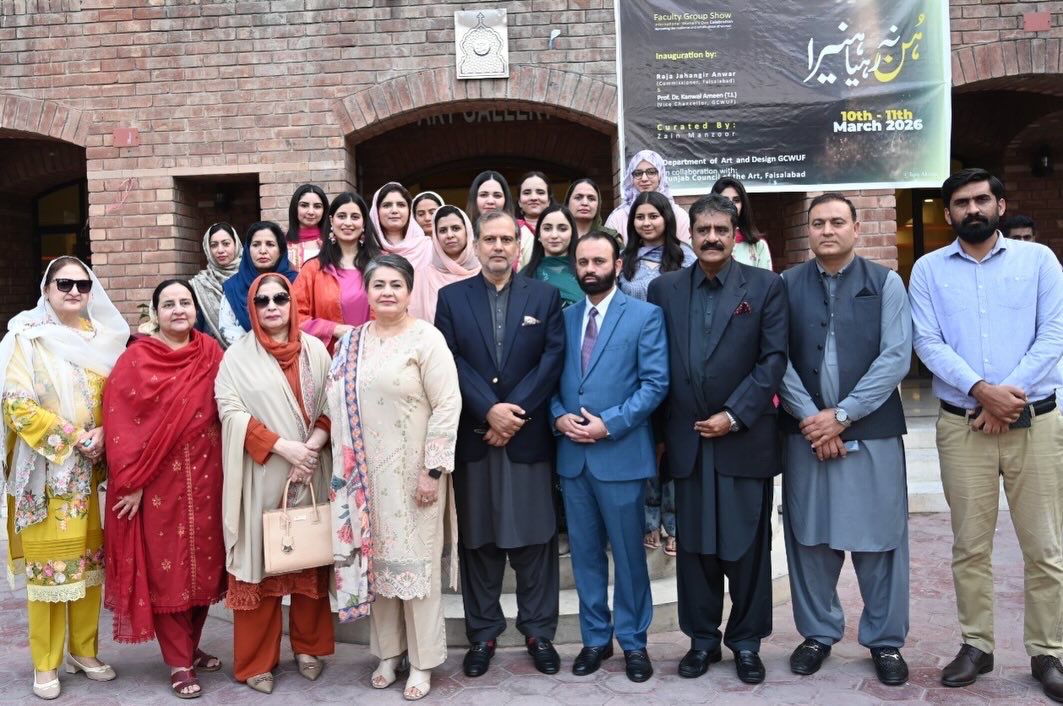
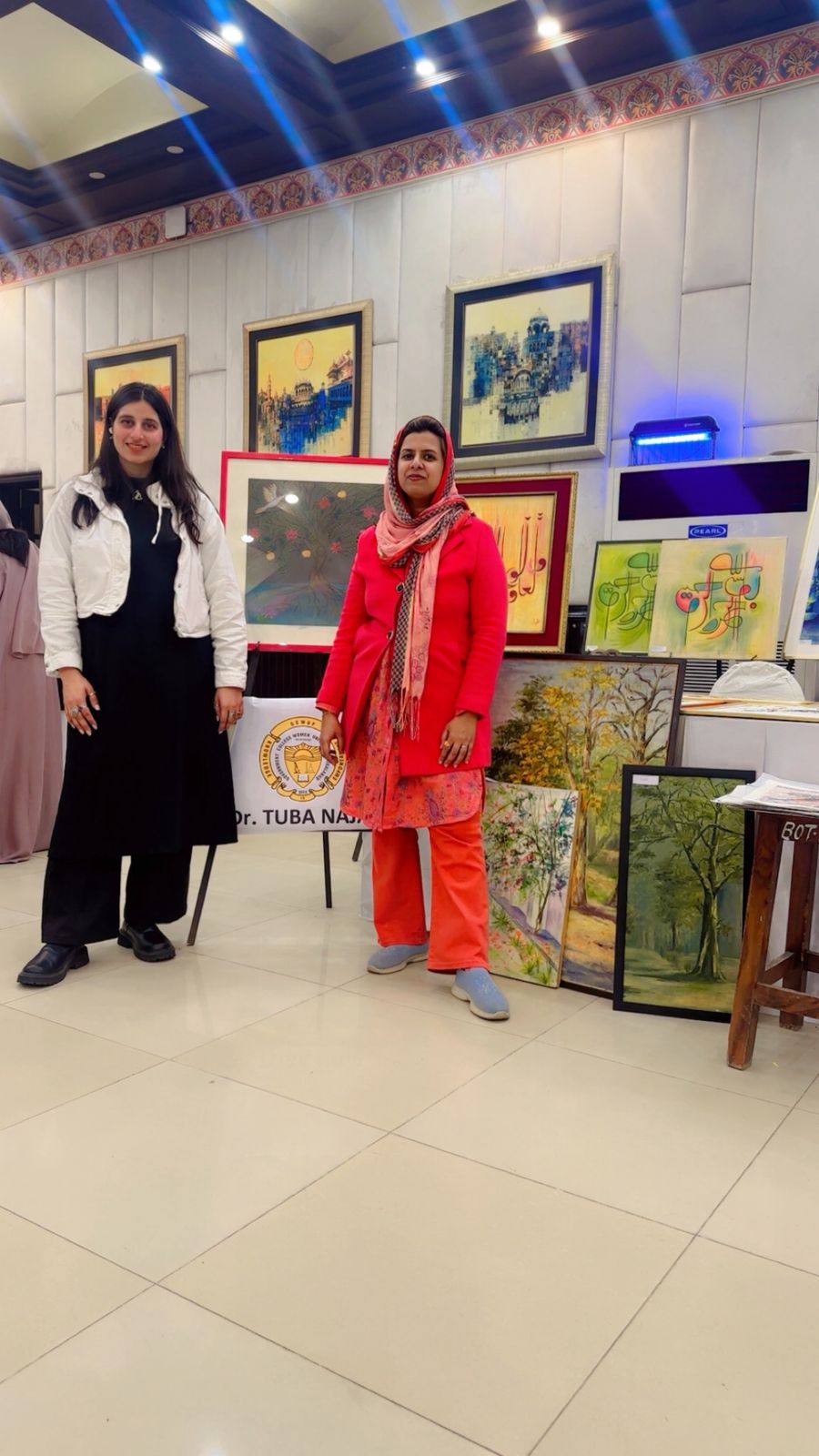
Department of Art and Design (previously Department of Fine Arts) was established in the late 1950s. It is the oldest Fine Arts Department in the city of Faisalabad. The Department started its first intake of Bachelors of Fine Arts in October 2015. It offers high quality specialized education in Visual arts including Painting, Miniature Painting and Printmaking as well as Visual Communication Design (Graphic Design) since 2018. In keeping with the decades old tradition of imparting knowledge and power of critical thinking to the students, Department of Art and Design remains dedicated to the teaching of Visual Arts and Design while encouraging curiosity and experimentation among the emerging Artists in the field.
In keeping with the university's goal of Women Empowerment through quality education, the heart of our program is the individual artist's quest for beauty, harmony, unity and thought-provoking artwork. With solid technical foundation, the current generation of young artists may revive a higher form of art and may become useful and financially independent individuals of the society.
By promoting cultural ideals of craftsmanship, mastery and ingenuity, we celebrate the individual emergence of creativity. We hope to prepare our future artists and designers with the capacity to use their art as an instrument for social change and for positive impact on the society.


| Title | Fee Structure |
|---|---|
| Associate Degree (2-Year), B.Ed. (1.5-Year), B.Ed. (2.5-Year) – Morning 2026 | View |
| Associate Degree (2-Year), B.Ed. (1.5-Year), B.Ed. (2.5-Year) – Evening 2026 | View |
| BS - Morning 2026 | View |
| BS - Evening 2026 | View |
| MS/M.Phil. - 2026 | View |
| Ph.D. – 2026 | View |
NADIA ZAFAR
In: The Two Legends of Pakistani Art: Mansoor Rahi and Hajra Mansoor,editor,(eds.)title series title and number,2788-6255,Nil;South Punjab Center for Research and Development,31-DEC-21. p.371-389 |
NADIA ZAFAR
In: Pearl, Roses and Turbans: A Formalist and Comparative Study of Symbolic Elements in Mughal and Fresco Portraiture,editor,(eds.)title series title and number,2710-0057,H#269,Street 4,Sector F6,Phase 6,Hayatabad Pakistan;International Research in Management and Business Realities,13-JUL-25. p.37-42 |

.jpeg)

Develop and maintain a highly effective, reliable, secure, and innovative Campus Management System (CMS) to support instructional, administrative, and research functions of the university. Under the CMS, the following modules are developed and implemented:
This application is used for online admission both for undergraduate and graduate programs. Candidates can apply online and after merit lists are made, they visit the University for Fee Submission. All admission-related information is available on the university website.
This application is used for student registration. After obtaining admission, all students are registered and student cards are issued through this application.
This computerized system is used for keeping all records about the students. Student basic data, previous academic records, present academic records, and other student-related records are managed under this application.
This system is used for managing all semester-wise fee collections from the students. Computerized fee vouchers are issued to the students. The fee office collects fee collection data from the banks and compiles it for further processing.
After fee submission, students enroll in their courses against a particular semester. This system keeps all records related to semester-wise enrollment.
After enrollment, a central computer-based timetable is prepared. Teachers are allocated different courses. Classes, courses, and teacher combinations are managed under this application. This application is used for online student attendance.
On the basis of enrollment and class formation by using this system, teachers can enter the award lists online. As soon as a teacher enters the award list, this result is displayed online under the student portal.
Serves the controller of examinations office. All semester-wise results are prepared and notified. Different reports for all levels of management and students are prepared through this computer-based system. Declared ITS BS batch result within a short time.
This application is developed for QEC, GCWUF. Students are provided with the opportunity of evaluating their courses and teachers online. Different reports are prepared for comprehensive analysis purposes.
The faculty portal provides authorized dynamic options to add new employees, edit employee profiles, view current staff rosters, and manage employee records with extensive details.
Developed for each department to easily upload distinct material like introductions, vision, and mission statement details, academic program summaries, achievements, galleries, and daily dynamic activities updates.
Enables focal persons to manage course enrollments dynamically by section or teacher, authorize leaves, design schedules, assign dynamic slots to alternative departments, check scheme of study, and check employee payroll files.
The dedicated teacher portal contains real-time student attendance management features, direct online lecture sharing, and dynamic online assignment configuration panels.
Provides robust automated tools specifically allocated for generating faculty fee vouchers alongside maintaining systemic records of entire faculty collections.
Equipped with full access points to monitor student voucher transaction logs, comprehensive automated tracking rows for fee records, and scroll data entry options.
Students securely log in using registration numbers and CNIC details to view customized fee structures, manage module selections, review attendance summaries, and verify results sheets or evaluation parameters.
A dedicated structural portal crafted cleanly for HEC compliance processes, facilitating instant uploads for statutory Performa-2 and Performa-5 validation sets.
Handles structured setup for standard intermediate level entries:
Administrative console for standard intermediate programs:
Facilitates seamless document transfers between university departments:
Accountability framework using facial recognition modules:
Enables staff members to record dynamic credentials, academic history timeline portfolios, core research competencies, running industry projects, and scientific publication lists safely.
The services of ITS
Deliver information technology products and services that meet the needs of the University and achieve the highest level of satisfaction of the students, faculty and other university staff satisfaction. Support the use and development of information technology to enable academic innovation in teaching, learning, research, and administrative activities of the university.
.jpeg)

.jpeg)
.jpeg)
.jpeg)